Crash games have long been a part of everyday gaming: short rounds, rapid growth in odds, and a sense of will it make it or won’t it? There are many projects on the market that copy the same formula and differ only in their design. Mine-Island at https://mine-island.net/ stands out from the crowd not because it is just another crash game, but because it rebuilds the genre around player choice, understandable risk, and spectacular, live presentation. For the Indian audience, where dynamics, mobility, and clear rules are particularly valued, this direction seems especially appropriate.
Shift in Focus: Not Line and Timer, but Path and Decisions
Classic crash mechanics are most often based on a single action: the coefficient grows, the crash occurs at any moment, and the whole intrigue hinges on choosing the right moment to exit. It works, but quickly turns into autopilot: the rounds are similar to each other, and the emotions depend almost entirely on the speed of growth.
Mine-Island changes the perspective: instead of an abstract graph, there is a sense of a route. The gameplay is perceived as moving through a chain of stages, where each subsequent step increases the potential result, but at the same time increases the tension. As a result, the game feels not like waiting for an event, but like a story in miniature — with a sequence of micro-moments that are psychologically more memorable than identical rounds.
Hybrid Nature: Crash Dynamics + Field and Step Logic
The main idea of Mine Island game is hybridity. The game retains its crash nerve (the risk increases, and the round can end suddenly), but adds a structure similar to moving across cells/tiles, where each transition is a separate risky episode.
This makes Mine Island different in three important ways:
- Fragmentation of tension: instead of one climax, there is a series of small climaxes.
- Meaningful progress: growth is perceived not as a number on a screen but as distance travelled.
- Subjective sense of control: even when the outcome is random, the step-by-step format creates a feeling of participation rather than passive observation.
This is what often appeals to players who enjoy arcade-style games — the feeling that the game responds to their actions and keeps up the pace.
Partial Exit as a Kind of Insurance for Emotions
In many crash games, the choice is binary: either exit now and take the result, or continue and risk everything. Mine Island offers a softer psychological mechanic — partial fixation of the result at certain stages.
This solution changes the genre at the level of sensations:
- the risk becomes graded, rather than just all or nothing;
- players perceive sessions more calmly because the game allows for scenarios where part of the result is already fixed and part continues to play on;
- there is a variety of behaviour: some prefer a more cautious pace, others a more aggressive one, and this is reflected in style, not just luck.
For an audience accustomed to short but sweet mobile sessions, this mechanic is particularly valuable: it reduces the feeling of empty rounds and makes the dynamics more stable.
A Visible Ceiling and Understandable Maths: Less Fog, More Trust
Another rarity for the genre is the clear framework of potential outcomes. Mine-Island has clear parameters: average volatility, a high stated RTP in the range of 96–98%, and a maximum multiplier that can reach 100x. When a game does not hide its basic characteristics behind magic, players perceive the process as more transparent and honest in relation to their expectations.
It is also important that the structure of the steps makes the math more intuitive: each successful stage feels like a logical addition to the potential. This lowers the barrier to entry — even for those who don’t like dry numbers, the picture remains clear: the further you advance, the higher the potential reward, but also the higher the chance of losing the round.
Pace and Comfort: The Game is Designed for Mobile Habits
The Indian audience is largely mobile: short gaming windows, commutes, sessions between tasks. Mine-Island fits well into this rhythm thanks to two things:
- Short rounds with a high density of events. There are more small payouts in one round than in a typical crash round.
- Speed control. The accelerated pace and automation are perceived as a comfort setting rather than a complication. Players can choose how fast the service will be, which is especially convenient when travelling or during short breaks.
As a result, Mine-Island feels like a game made with an understanding that modern users are not always ready for long, monotonous cycles.
Visual Presentation: Not a Neutral Interface, But a Memorable Character and Atmosphere
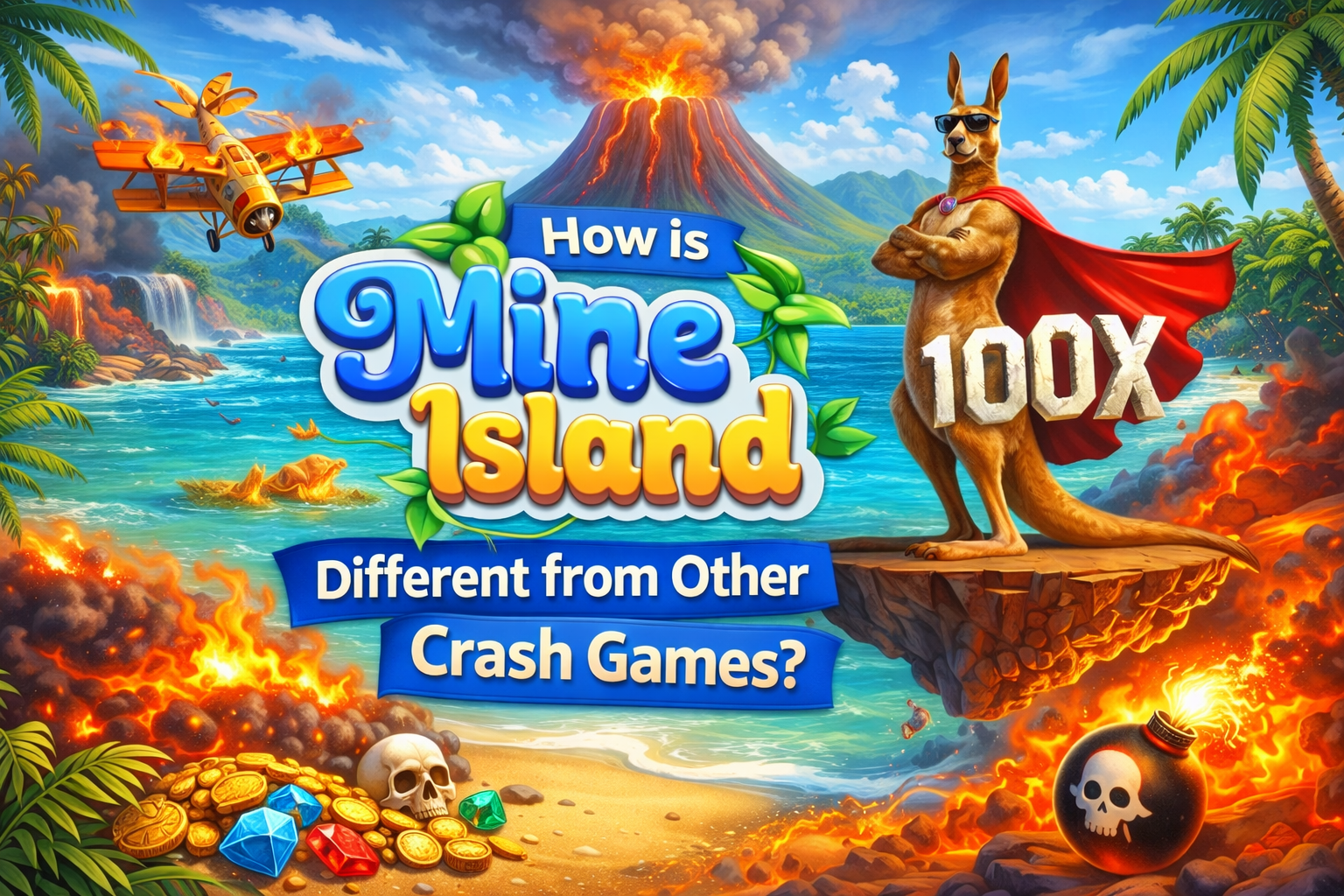
Most crash games are visually minimalistic: graphics, numbers, buttons. Mine-Island builds recognition through its storyline: a tropical island, cartoon style, hero character, and animations that turn the growth of the coefficient into a small adventure.
This works in several ways:
- it reduces the sterility of the genre — the game looks friendlier and livelier;
- it makes the project more watchable — it’s interesting to observe what’s happening, which enhances its social potential;
- it helps to retain the attention of those who are tired of identical interfaces.
For players who like it when gambling mechanics have a distinctive flavour, Mine-Island is a notable exception.
Conclusion: Mine-Island is an Evolution of the Genre Rather Than Just Another Clone
Mine Island game online differs from other crash games not only in one parameter, but in its overall philosophy: to give the player more tangible decisions, make the risk more understandable, and the process more visually and emotionally rich. A hybrid of steps and crash nerves, partial fixation of results, an emphasis on verifiability and statistics, a mobile pace and a vibrant atmosphere — all this comes together in a product that is perceived as a separate direction within the genre.
Mine-Island is particularly interesting for the Indian audience because it combines the familiar dynamics of fast-paced games with a more human presentation and clear logic of progress. As a result, it is not just another variation on the crash formula, but a notable attempt to make the genre smarter, more convenient and more spectacular — while retaining the most important thing: the adrenaline rush of a short round and the pleasure of a successful decision.